- Vendu


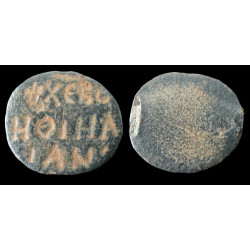
Aetios, hypatos (?) – Sceau conique en plomb tardo-romain / proto-byzantin – Ve siècle
A/ Monogramme en bloc lisant ΑΙΤΙΟΥ ὙΠΑΤΟΥ (Aitiou Hypatou), surmonté d’une croix
Ø 20 mm ;  8.15 g.
Réf : Boersema/Dalzell, Vossen Collection 183 ; Berlin II, 470 (monogramme lu comme eparchos ?) ; Seyrig 359 ; Spier, Late Antique and Early Christian Gems, n° S29.
Le sceau est commun mais l'exemplaire superbe !
L’interprétation de ce monogramme a longtemps été débattue. Plusieurs lectures ont été proposées : Pelagios (Cheynet, Antioche, 141–142), Apelates, Apellios, Paeitos (Seyrig 359). Le grand nombre de sceaux portant ce monogramme a suggéré à certains qu’il désignait un office plutôt qu’un individu, utilisé par plusieurs titulaires successifs.
C. Sode, suivant N.P. Likhachev, a proposé eparchos (ἐπάρχος, préfet) ou tou eparchou (du préfet), mais cette lecture est difficile à soutenir car les lettres P et X sont absentes.
W. Weiser a avancé la lecture epistatou (ἐπιστάτου, « de l’inspecteur »), non attestée comme charge d’État, mais pouvant désigner un responsable fiscal ou l’administrateur de domaines publics ou privés.
Ici, c’est la lecture proposée par Werner Seibt – Aetios, hypatos – qui est retenue, identifiant le sceau comme celui d’un haut dignitaire portant le titre honorifique de consul.