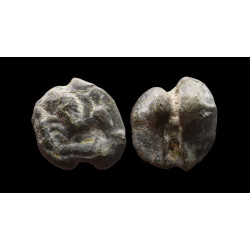
A/ Dans un cercle de grènetis, buste de la Vierge, nimbe, tenant l’Enfant-Christ sur son bras droit ; l’Enfant est nimbe crucigère.
R/ Dans un cercle en anneaux de chaîne, monogramme cruciforme. Lettres lisibles β - ν - ο - σ - υ, formant le nom Βονόσου.
Le monogramme livre clairement le nom Bonosos, avec une graphie inhabituelle, la forme attendue étant Βονώσου, confusion courante entre ο et ω.
Ø 18 mm ;  6,00 g
Réf : BZS.1958.106.4117 (Dumbarton Oaks, même boulôtèrion)
Sceau byzantin du VIᵉ–VIIᵉ siècle, caractéristique des productions tardo-antiques associant une iconographie mariale au droit et un monogramme nominatif au revers. Le nom ΒΟΝΌΣΟΥ est clairement lisible dans le monogramme cruciforme ; son orthographe est inhabituelle, la forme attendue étant ΒΟΝΏΣΟΥ. La substitution de ο à ω constitue cependant une erreur graphique fréquente dans la documentation sigillaire byzantine.
Le sceau est issu du même boulôtèrion que l’exemplaire conservé à Dumbarton Oaks.
Fiche technique